
Last updated on June 12, 2026
5 Elements of a Modern Data Strategy
By Christina Salmi
A modern data strategy gives you the structure to meet those demands. It clarifies priorities, aligns teams, and contains a roadmap to guide and track progress on your data initiatives.
In this blog, we discuss the key components of a data strategy — plus, get access to our Data Strategy Stakeholder Interview Guide to help you shape a data strategy that gets adopted.
Table of Contents:
- Alignment with Business Objectives ↵
- Free Download: Data Strategy Stakeholder Interview Guide ↵
- Modern Data Stack ↵
- Data Governance ↵
- Scalable Talent Strategy ↵
- Data Strategy Roadmap ↵
What is a Data Strategy? (And What It’s Not)
A data strategy is the foundation for all your data practices. It’s a long-term, guiding plan that defines the people, processes, and technology necessary to solve your data challenges and support your business goals.
A data strategy isn’t a quick fix for your data problems — and it addresses more than just data. It serves business needs through the lens of data, anticipating what needs to happen to meet your company’s specific objectives.
A successful data strategy clarifies:
- How employees can use data more effectively.
- Which processes ensure access and data quality.
- What tech and architecture support data storage, sharing, and analysis.
The goal of a data strategy is to answer the question of how the entire organization can leverage data in support of making optimized business decisions, and build a plan that defines the people, processes, and technology to bring it to life.
Why is a Data Strategy Important?
Without a modern data strategy to guide your data practices, you risk making poor decisions, missing opportunities, and stalling innovation. Specifically, you’re likely facing common data challenges such as:
- Inability to make timely or proactive decisions because reporting represents the past
- Not utilizing or misusing advanced approaches like generative or agentic AI
- A tech stack that doesn’t scale with evolving needs and has low adoption across the org
- Locked into a single vendor for various parts of the data lifecycle
- Inconsistent, poorly defined, or undocumented definitions for metrics and KPIs
- Too many manual practices and time spent on data prep and integration
- Data quality and data access issues
- Data stuck in silos and departments working from different “truths”
- Users too dependent on IT
A modern data strategy turns scattered efforts into a unified, organization-wide plan.
As AI, automation, and self-service analytics are now table stakes for remaining competitive, a strong data strategy ensures your business is positioned to adapt and take on new opportunities with confidence. Yet most organizations allocate only 14% of their AI and analytics budgets to strategy itself — underinvesting in the foundation that determines whether these initiatives deliver results.
Your data strategy framework anchors all your data initiatives. It keeps you focused, aligned, and ready to adapt when demands shift, new tools emerge, or business priorities evolve.
Our 5 Elements of a Data Strategy
We’ve helped more than a thousand companies with varying levels of analytical maturity craft their modern data strategy and make better use of data. Our extensive experience has resulted in identifying the following key components of a data strategy.
1. Alignment with Business Objectives
Your data initiatives must solve real business needs to deliver value. Without this focus, you risk prioritizing the wrong projects, missed insights, losing trust in your data — and ultimately — wasted time and resources.
When your data initiatives align with company goals and stakeholder needs, you gain business buy-in — making it easier to execute your data strategy and see faster returns on your investments.
How to align your data strategy with your business objectives:
- Identify your organization’s current objectives and the KPIs being used to measure success.
- Identify departmental business drivers that could be positively impacted by improved data and analytics.
- Demonstrate how planned data initiatives directly support departmental activities and advance overall business objectives.
A Step You Can’t Miss: Stakeholder Interviews
Stakeholder interviews serve two purposes: they provide the inputs you need to shape a strategy that solves business problems; and they inspire buy-in.
This is your time to document the business drivers each team is focused on, the questions they’re trying to answer, and what’s needed to get there.
Interview executives and department leaders to uncover their:
- Current state (KPIs, tools, reports, data sources, dependencies, etc.)
- Overall goals and what they are trying to accomplish
- Specific questions they want answered
- Where gaps exist in their processes, tech stack, and people
We’ve broken out the questions by three stakeholder groups: the Executive and C-Suites, Department Leads, and IT Leads. Use the role-specific questions to capture KPIs, pain points, dependencies. These inputs will shape the use cases to include in your data strategy roadmap.
Ask executives how data supports business goals so you can align your strategy with their long-term priorities. Here are some sample questions:
Goals and Strategic Alignment
Current State
Opportunities and Ideal State
Download the full guide to access the complete questionnaire
Ask department leads about their data needs to uncover use cases that improve daily performance and meet corporate objectives. Here are some sample questions:
Goals and Strategic Alignment
Current State
Reporting and Tools
Download the full guide to access the complete questionnaire
Ask IT leads about systems and process gaps and opportunities to uncover use cases that improve integration, automation, and scalability. Here are some sample questions:
Current State
Tools and Architecture
Data Flow and Processing
Download the full guide to access the complete questionnaire
The stakeholder interviews are critical to forming a data strategy that is evidence-based — and it’s the difference between a strategy that gets adopted and one that becomes expensive shelfware.
Questions for the C-Suite should lean toward how data supports corporate objectives, so that you can discover what may help or hinder data strategy progress:
- What is your vision for the company in the next 3-5 years?
- Do you have specific architecture or tool preferences?
- What do you need to see to gauge the performance of the business?
- How interested are you in utilizing agentic AI for self-service analytics?
Questions for business unit leaders and IT functions should equip you with everything you need to formulate use cases for your data strategy roadmap:
- What KPIs matter most to your team, and are there any missing that you need?
- What is the process for data ingestion, transformation, and mapping?
- What is your anticipated data volume growth annually for next 3-5 years?
When stakeholders see their needs reflected in the data strategy, they’re far more likely to champion it.
2. Modern Data Stack
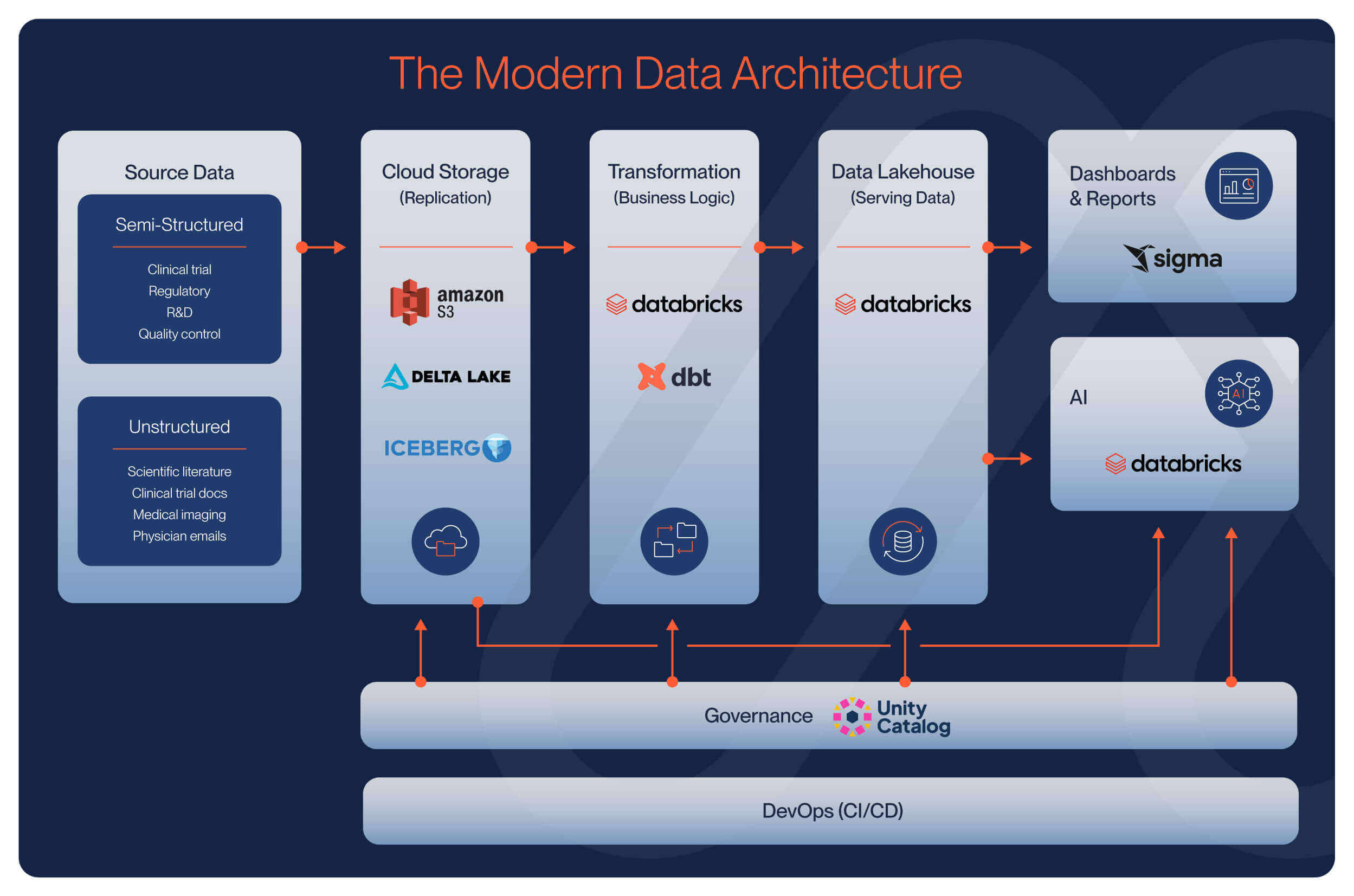
With so many data and analytics technologies available, it is easy to get distracted or overwhelmed by the options. Don’t chase hype — stay focused on your strategic goals. When selecting your tech stack, think bigger than your reporting needs. Your tools should work cohesively to support a scalable architecture, streamline workflows across the entire data lifecycle, and make data teams more efficient.
Your technology should also promote agility so you can easily tackle what’s next on your roadmap — whether that’s self-service analytics, retiring legacy systems, or AI-driven use cases that rely on clean, connected data.
To navigate the noise and choose a tech stack that works best for your org:
- Use established methodologies and proven tech combos. Use combinations that are known to work well together and support a scalable architecture (i.e., Databricks + dbt + Sigma).
- Address the entire data lifecycle. Ensure each stage has the right technology and processes in place to maintain data integrity and produce the most value.
- Who will use the tech, and does it meet their needs?
- Are business users able to extract important insights intuitively and quickly?
- Can teams across the org easily access and act on data?
- Do the tools speed up data processes and allow data teams to focus on higher value work?
3. Data Governance
Data governance is necessary for consistent, high-quality data and analytics. Without it, you run the risk of using data inappropriately, low analytics adoption, and redundant data practices. Done right, it creates confidence in your data and guarantees AI readiness. If your governance practices are weak or inconsistent, your analytics and AI outputs will reflect that — inaccuracy and risk included.
There are powerful governance tools integrated into data platforms that can make governance more seamless (e.g. Unity Catalog in Databricks), but data governance itself is not a software application or tool. Governance is a managed function that requires clear policies and a plan encompassing your people, processes, and technology to meet internal and external data standards (e.g. GDPR, CCPA, and PCI DSS).
Make It Right Sized and Practical
Implementing data governance carries a high risk of low adoption if not done correctly and can get costly fast. To avoid this, the data governance program you outline in your data strategy should match your company’s needs, size, urgency, maturity, and capabilities.
For example, organizations just getting started with governance may immediately benefit by establishing a business glossary that defines all available end-user measures and dimensions, while more mature organizations harnessing AI may need to update their org chart to establish clear accountability for AI outputs.
Tips for a Successful Data Governance Program
- Make governance practical, not overbearing. Adoption of your data solutions happens when data governance is realistic and can be integrated into everyday workflows and operations without major disruption.
- Make it people-centric (not technology-centric). While technology assists in reliable execution of data governance, a governance program succeeds when people drive work that results in higher quality, trusted data.
- Start where data quality issues cause the most pain. Focus on high-impact areas and build on the momentum from those wins to keep expanding governance.
- Align to business needs. Like all your data initiatives, governance should support the goals of the business above all else. You’ll get buy-in when you illustrate how governance initiatives support strategic objectives, such as operational efficiency and innovation.
- Make it adaptable. A successful governance program evolves with your organization’s data maturity and business priorities. As data governance activities expand and more people take on data governance responsibilities, each new component should be assessed and formally integrated into your program.
4. Scalable Talent Strategy
Talent is critical to a data strategy — without the right people in the right roles, your investments in technology, processes, and plans will fail to deliver. People are the key to executing your data strategy and creating a data-driven culture.
A strong data team depends on three things: the operating model, team structure, and enablement.
Operating Model
Define your operating model — which is how the data team works to support the business. There are many operating models, but most can be classified as decentralized, centralized, or hybrid. Your operating model shapes your org chart and the level of governance, autonomy, and collaboration needed across teams.
- Centralized operating model concentrates ownership within a core data team that serves the entire org. This model promotes consistency and control and can be ideal for early-stage or highly regulated orgs.
- Decentralized operating model distributes responsibilities across departments, where each unit manages its own data resources. This model speeds up domain-specific insights but there is risk for inconsistent use of data without the right governance.
- Hybrid operating model combines both approaches but typically has a central data platform and data team responsible for overall infrastructure and governance, while business units have embedded and dedicated data professionals.
Team Structure
Data teams look very different than they did even five years ago. Cloud platforms and AI have reshaped how data gets delivered and who’s involved. Teams are less siloed, less reactive, and more focused on driving business outcomes — not just fulfilling requests. That shift directly impacts how you structure your team and define responsibilities.
- Do you have the technical talent to support activities across the full data lifecycle?
- Have you clearly defined, documented, and aligned roles and responsibilities to your data strategy?
Take stock of where your gaps are and determine a plan to hire or upskill existing talent.
Training and Enablement
Your modern data strategy will introduce new technologies, responsibilities, and ways of working. Whether it’s development workflows or innovations with AI, your teams need to know not just what’s changing — but why it matters, and how to adapt.
Focus enablement on:
- Business context, so teams understand how their work contributes to outcomes
- Core data literacy across business functions
- Ongoing skill development, including tool — and platform — specific training
- Practical guidance for responsible and productive AI use
Clarity fosters accountability: make sure your teams understand their expectations, how they’ll be supported, and how success will be measured.
5. Data Strategy Roadmap
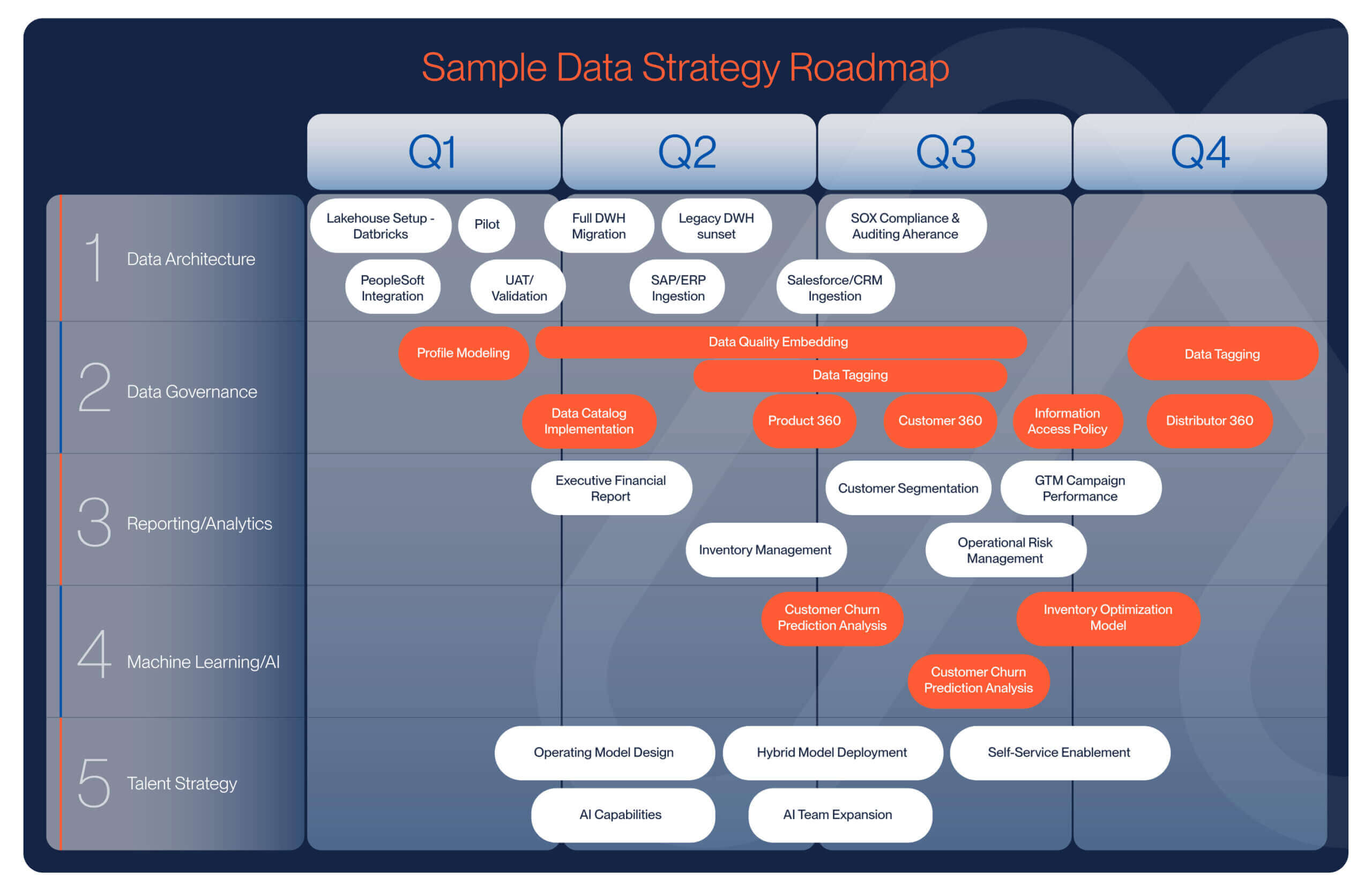
Your data strategy roadmap is a structured, time-bound plan for executing on your data strategy. It factors in your current organizational maturity and articulates what steps should be taken — in what order, and by whom — to reach your goals.
The roadmap should include prioritized initiatives aligned to business goals, preliminary tech and talent considerations, key milestones and timelines, and known risks or dependencies.
Prioritization Matters
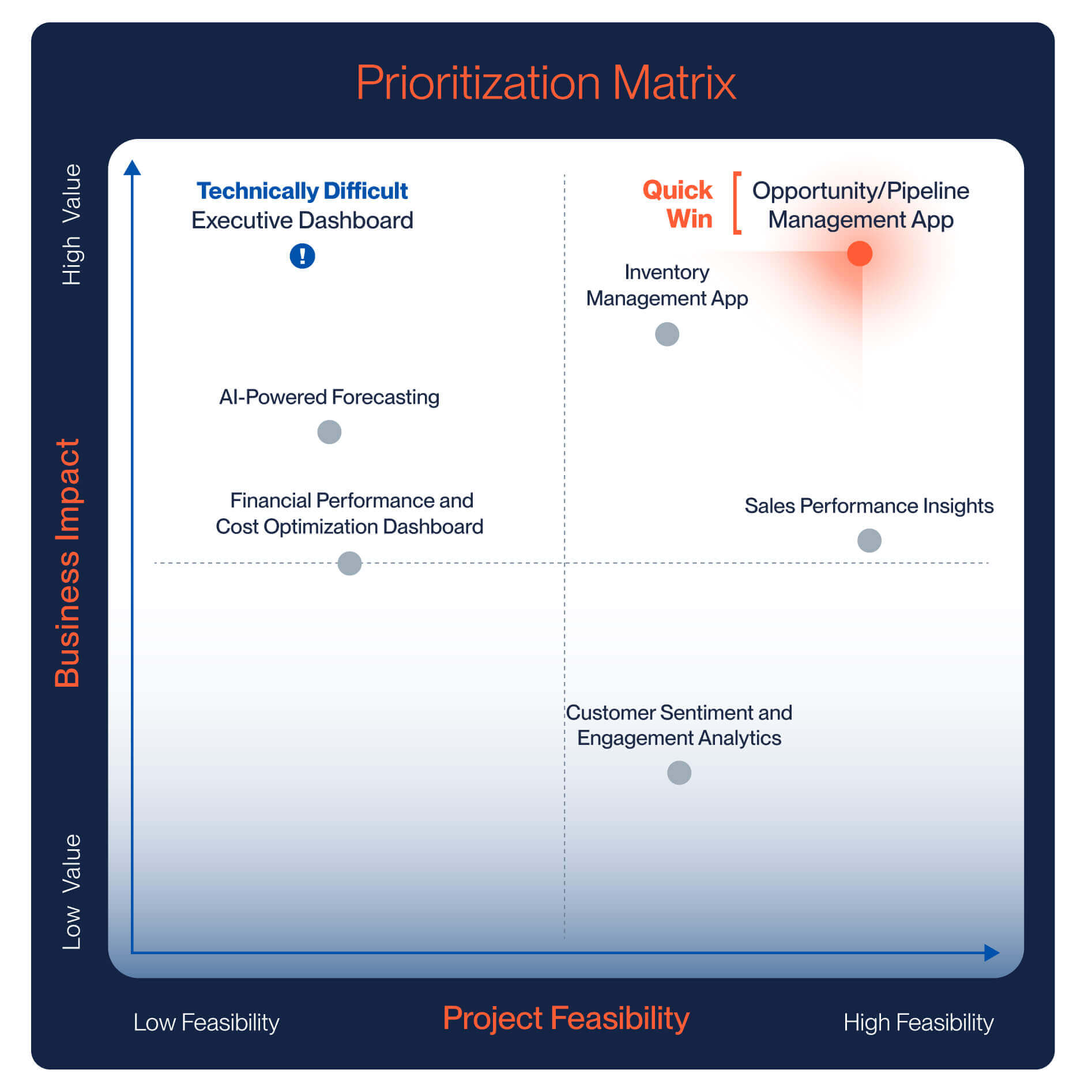
Strategic prioritization prevents wasted effort and allows you to take a measured approach to resource planning. Before changing your tools, processes, or teams — get clear on which data initiatives should occur first, and why.
For each initiative outlined in your data strategy, define the feasibility and expected business value it will provide. Prioritize activities that are easiest to implement but expected to return high value to the business.
Other factors to consider when plotting your path forward:
- Staffing and availability, including whether you’ll need to hire or bring in outside help
- Cost and your company’s budgeting process, especially if a capital investment is required
- Competing projects that may impact timing or prevent key resources from participating
- Major company milestones, like product launches or M&A, that could reshape priorities midstream
Key Takeaways
- A modern data strategy aligns people, processes, and technology to make data accessible, trustworthy, and actionable in support of business goals.
- An effective data strategy starts with alignment to business objectives, using stakeholder input to define outcome-driven use cases.
- Stakeholder interviews are the foundation of adoption. They capture real business needs and secure buy-in, making your strategy executable instead of shelfware.
- A modern data strategy requires the right data stack — scalable, cohesive, and governance-ready — to support analytics, AI, and future growth.
- Data governance is a core part of any data strategy. Practical, people-driven, and adaptable governance ensures high-quality, trusted data and compliance.
- A strong talent strategy underpins data strategy execution by defining operating models, clarifying roles, and building data literacy across teams.
- A data strategy roadmap provides the structure and prioritization needed to focus resources on the highest-value, most feasible initiatives.
- Modern data strategies must evolve. Iteration keeps the roadmap relevant as business priorities, tools, and technologies change.