
Last updated on June 22, 2026
A Better Approach to Data Analytics Projects: The Analytics8 Delivery Methodology (ADM)
By Travis LaMont
Data and analytics projects are no longer isolated technology initiatives. They sit at the center of business transformation, AI adoption, and enterprise decision-making. At the same time, they have become increasingly complex, requiring coordination across business and technical teams, evolving requirements, and rapidly changing technologies. Delivery must do more than keep tasks moving- it needs to keep priorities, decisions, timelines, risks, and outcomes aligned from start to finish.
The Analytics8 Delivery Methodology (ADM) gives that structure to every engagement. It brings together experienced delivery leadership, practical governance, iterative execution, and business alignment so teams can adapt without losing focus on the value they set out to create.
In this article, we’ll explain how ADM works, the core disciplines behind it, and why a delivery approach built specifically for data and analytics helps organizations move from planning to measurable impact with more clarity and accountability.
Table of Contents:
- Why You Need an Iterative and Practical Approach to Data and Analytics ↵
- The Key Components of the Analytics8 Delivery Methodology (ADM) ↵
- The ADM Advantage: Why ADM is Better and Different ↵
- A Better Delivery Experience for Modern Data Initiatives ↵
Why You Need an Iterative and Practical Approach to Data and Analytics
Data and analytics projects rarely succeed in a perfectly linear way.
As projects progress:
- Priorities evolve
- Business questions become clearer
- New dependencies emerge
- Data quality issues surface
- Stakeholders refine expectations
- Opportunities for greater business value emerge
Traditional project approaches often struggle in these environments because they rely on rigid upfront assumptions or treat delivery governance as an administrative exercise rather than an active part of delivery success.
At Analytics8, we take a different approach.
We believe successful delivery requires:
- Continuous alignment between technical work and business objectives
- Structured prioritization and sequencing
- Active management of risks and dependencies
- Flexibility to adapt as organizations learn and mature
- Delivery leadership that understands both the technology and the business impact
Most importantly, we believe project management in data and analytics engagements must be led by experienced delivery professionals who understand the realities of implementation, not simply by administrative coordinators tracking tasks and meetings.
Our Project Managers are experienced delivery leaders who have worked directly in complex data and analytics environments. They understand how delivery decisions affect architecture, scalability, reporting, governance, adoption, and ultimately business outcomes.
That experience allows our teams to anticipate challenges early, stay focused on long-term value, and guide organizations through complex delivery decisions with confidence.
Key Components of the Analytics8 Delivery Methodology
The Analytics8 Delivery Methodology (ADM) is our proven framework for structuring, governing, and executing engagements to ensure consistent delivery, clear accountability, and alignment to business outcomes.
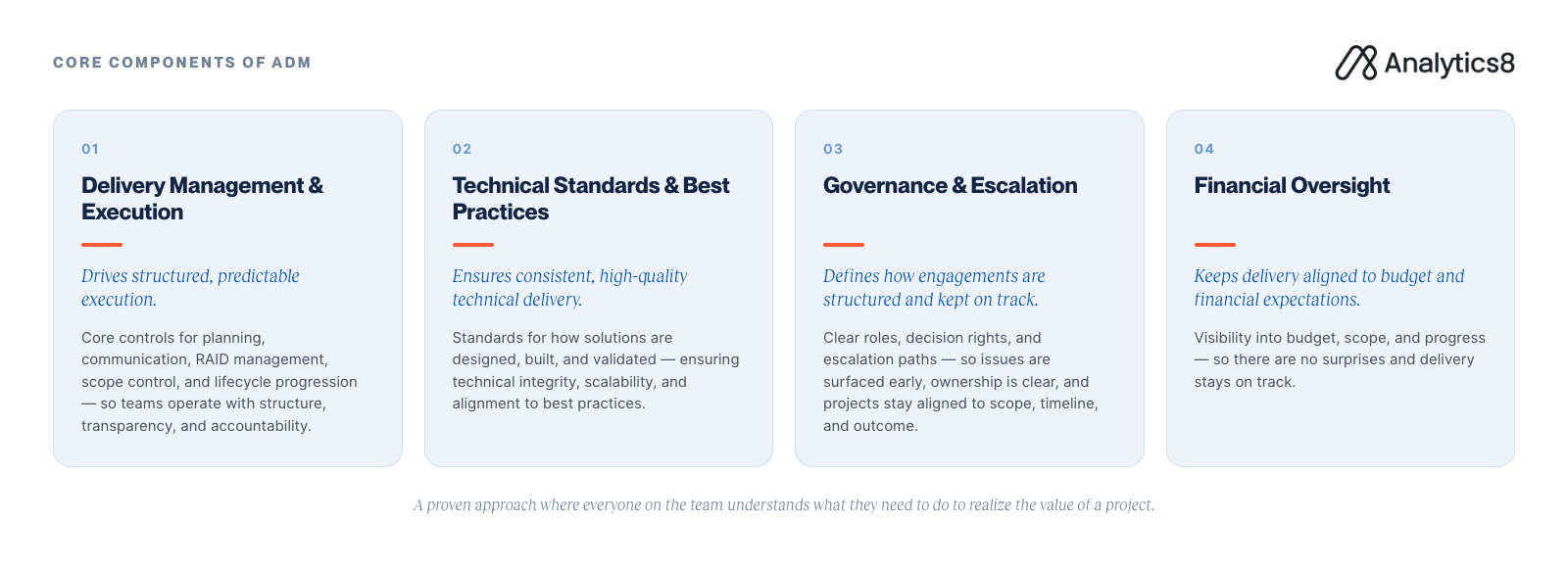
The four core components of ADM are:
Delivery Management and Execution
Drives structured, predictable execution. This includes core controls for planning, communication, RAID management, scope control, and lifecycle progression so teams operate with structure, transparency, and accountability.
Technical Standards and Best Practices
Ensures consistent, high-quality technical delivery. Standards for how solutions are designed, built, and validated help ensure technical integrity, scalability, and alignment to best practices.
Governance and Escalation
Defines how engagements are structured and kept on track. Clear roles, decision rights, and escalation paths help issues surface early, clarify ownership, and keep projects aligned to scope, timeline, and outcomes.
Financial Oversight
Keeps delivery aligned to budget and financial expectations. Visibility into budget, scope, and progress helps prevent surprises and keeps delivery on track.
These core delivery disciplines are built on 20 years of experience helping clients realize the value of their data and analytics investments. ADM is designed to keep projects aligned while still allowing flexibility as business needs evolve.
Each component plays a different role, but together they create a delivery model where teams understand what needs to happen, who owns each decision, how work should progress, and how success will be measured.
The ADM Advantage: Why ADM is Better and Different
Many consulting delivery models focus primarily on task execution or resource utilization.
The Analytics8 Delivery Methodology focuses on something broader: helping organizations consistently deliver business value through structured, experienced, and adaptable delivery leadership.
What makes our approach different is the combination of:
Delivery Expertise
Our delivery leaders understand data and analytics work because they have done it themselves. They bring practical implementation experience into project leadership rather than operating solely as coordinators.
Our Project Managers:
- Lead planning and delivery coordination
- Manage sequencing and prioritization
- Identify and mitigate delivery risks
- Coordinate across technical and business stakeholders
- Maintain alignment between delivery execution and business goals
Because our PMs have real-world delivery experience, they are able to engage at both the strategic and operational levels throughout the lifecycle of the engagement.
Structured Focus
The ADM creates structure, visibility, and accountability that help teams remain aligned to the right priorities even as projects evolve. Rather than treating delivery as a series of disconnected tasks, ADM provides a consistent framework for prioritization, communication, risk management, and execution across the engagement lifecycle.
Practical Governance
Strong governance should improve delivery, not slow it down.
ADM introduces structured controls that provide visibility and alignment while remaining practical and delivery focused.
This includes:
- Clear ownership and accountability
- Active backlog and prioritization management
- Transparent communication and escalation paths
- Ongoing risk and dependency management
- Consistent delivery planning and status visibility
The goal is not process for the sake of process. The goal is to ensure that teams remain focused on the highest-value work while maintaining delivery stability.
Long-Term Thinking
We focus not only on delivering immediate solutions but also on helping organizations build scalable, maintainable data and analytics capabilities that continue creating value over time.
Alignment to Business Outcomes
Our methodology is designed around business outcomes rather than isolated technical activities.
Every engagement is structured to ensure:
- Work remains aligned to business priorities
- Teams focus on delivering measurable value
- Stakeholders maintain visibility into progress and tradeoffs
- Delivery efforts support long-term strategic objectives
This helps organizations avoid the common trap of delivering technical outputs that fail to create meaningful business impact.
Built for Modern Data and Analytics Environments
The ADM was specifically designed for modern data and analytics initiatives including:
- Cloud data platform modernization
- Data warehousing and lakehouse implementations
- Business intelligence and reporting
- AI and advanced analytics initiatives
- Data governance and enablement
- Ongoing Data Team as a Service (DTaaS) engagements
Because the methodology was built specifically for these environments, it reflects the realities of modern data delivery rather than applying generic IT project management approaches to highly specialized work.
A Better Delivery Experience for Modern Data Initiatives
Successful analytics programs require more than strong technology. They require experienced leadership, structured delivery, and a methodology designed specifically for the realities of modern data environments.
The Analytics8 Delivery Methodology helps organizations:
- Reduce delivery risk
- Maintain focus on business value
- Improve alignment across stakeholders
- Adapt as priorities evolve
- Build scalable and sustainable analytics capabilities
Delivering successful data and analytics solutions is not just about implementing technology. It is about helping organizations make better decisions, move faster, and create long-term business value through data.