
Last updated on August 5, 2026
Databricks Best Practices: How to Maximize ROI from Databricks
By Michael Kollman
Databricks supports the entire data lifecycle — from data engineering and analytics to machine learning and AI. Its breadth also creates complexity, and decisions made early shape the platform’s long-term value.
Across Databricks implementations, we’ve found that the greatest returns come from clear decisions about platform design, governance, AI readiness, performance, and cost management.
Whether you’re evaluating Databricks, planning a migration, or looking to optimize an existing environment, these best practices will help you maximize the return on your investment.
Table of Contents:
- Building a Scalable Databricks Platform ↵
- Building Trusted Data Governance with Unity Catalog↵
- Building a Trusted Semantic Layer for AI & Analytics ↵
- Scaling Self-Service Analytics with Databricks Genie ↵
- Balancing Databricks Performance, Spend, and Business Value ↵
- Conducting a Databricks Health Check ↵
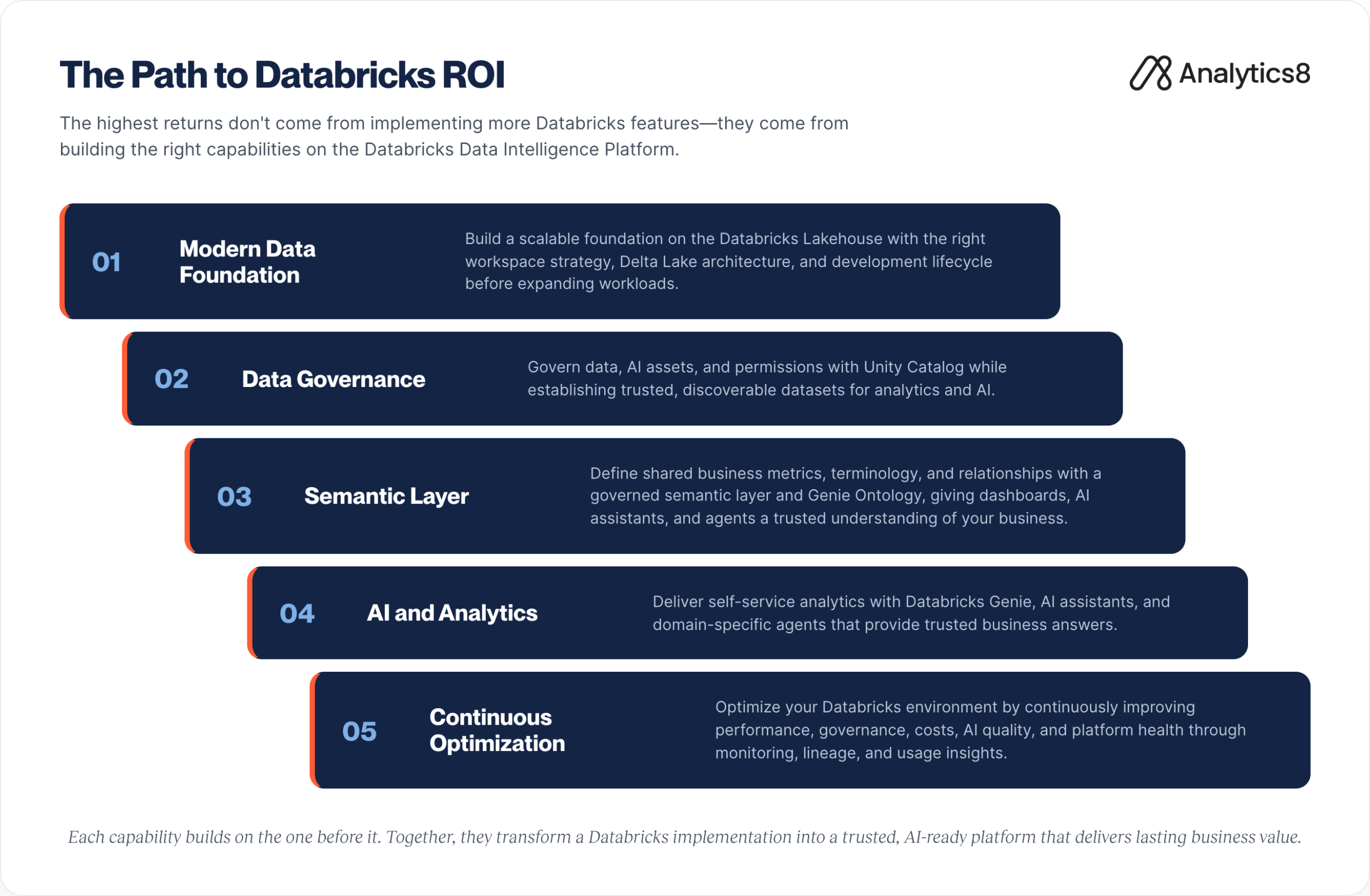
Best Practices for Building a Scalable Databricks Platform
A successful Databricks implementation starts with decisions about how the platform will be structured, governed, deployed, and operated as new teams and workloads are added. Establish these five practices early:
Design for the operating model the platform will need
Before building the first workload, define four elements of the operating model:
- Platform ownership. Assign owners for platform standards, access, and escalation before the first delivery team becomes the de facto platform owner.
- Workspace topology. Decide how many workspaces you need and how they map to environments and domains. Changing this structure later can disrupt access controls, deployment processes, and existing workloads.
- Onboarding paths. Define how new teams gain access and new data domains are introduced, so expansion follows a process instead of one-off requests.
- Workload requirements. Set the development, security, and governance requirements every workload must meet before it reaches production.
Together, these decisions give teams a defined path for expanding Databricks without redesigning the environment each time a new use case emerges.
Define performance requirements before selecting compute
Document the data volume, concurrency, completion window, response time, reliability, and recovery requirements for each priority workload. Use those requirements to select compute and configure auto-scaling rather than relying on one standard configuration across the platform. Monitor whether the workload continues to meet its requirements as usage grows and investigate the cause when it does not.
Treat promotion between environments as a release process
Keep development, test, and production environments separate. We recommend using CI/CD pipelines to promote Databricks assets between environments and enforce release gates for peer review, testing, data-quality validation, and approval for changes to permissions or business logic. This creates a consistent path to production instead of relying on manual promotion.
For one international brewer, Analytics8 implemented a CI/CD pipeline that automated Databricks deployments, reduced manual intervention, and delivered consistent, reliable updates across environments.
Make changes traceable and deployments repeatable
A reliable deployment process should answer four questions:
- What changed?
- Who approved it?
- Which version is running?
- How can the team roll it back?
Store notebooks, pipelines, configuration, and infrastructure in a git repository so teams can trace changes, identify deployed versions, and restore an earlier version when necessary. Declarative Automation Bundles (DABs) make deployments reproducible by packaging Databricks assets and separating environment-specific settings from the underlying code. Run production deployments under service principals to keep critical processes independent of an individual employee’s account.
Apply the same controls to agent-generated code: faster code generation increases the volume of changes teams must evaluate, not the amount of risk they should accept.
Require a thorough pull request template for agent-generated code, and use dedicated code-review agents to check for duplicated logic, inconsistent patterns, missing documentation, and other violations of development standards before a human reviewer approves the change.
Measure whether workloads deliver business value
Establish a baseline for the result the workload is expected to improve, such as delivery time, manual effort, data latency, operating cost, or decision turnaround time.
After launch, compare results with that baseline and review how people use the workload. Low adoption can signal problems with the use case, workflow, data quality, performance, or enablement. Diagnose the source before adding features.
Measure implementation speed by how quickly the organization reaches a governed, sustainable platform that users rely on, not by how quickly a workspace can be created.
After a three-year merger left Whetstone Distribution with four disparate ERP instances, Analytics8 built a centralized, governed Databricks platform designed to scale with its growth-through-acquisition strategy. The result was measurable: roughly 1,000 hours of manual reporting eliminated, and daily analysis in the hands of everyday decision makers instead of a select few.
Best Practices for Building Trusted Data Governance with Unity Catalog
Before configuring Unity Catalog, define how governance should operate: who makes decisions, what standards assets must meet, how users request access, and how the organization will maintain trust as the platform grows.
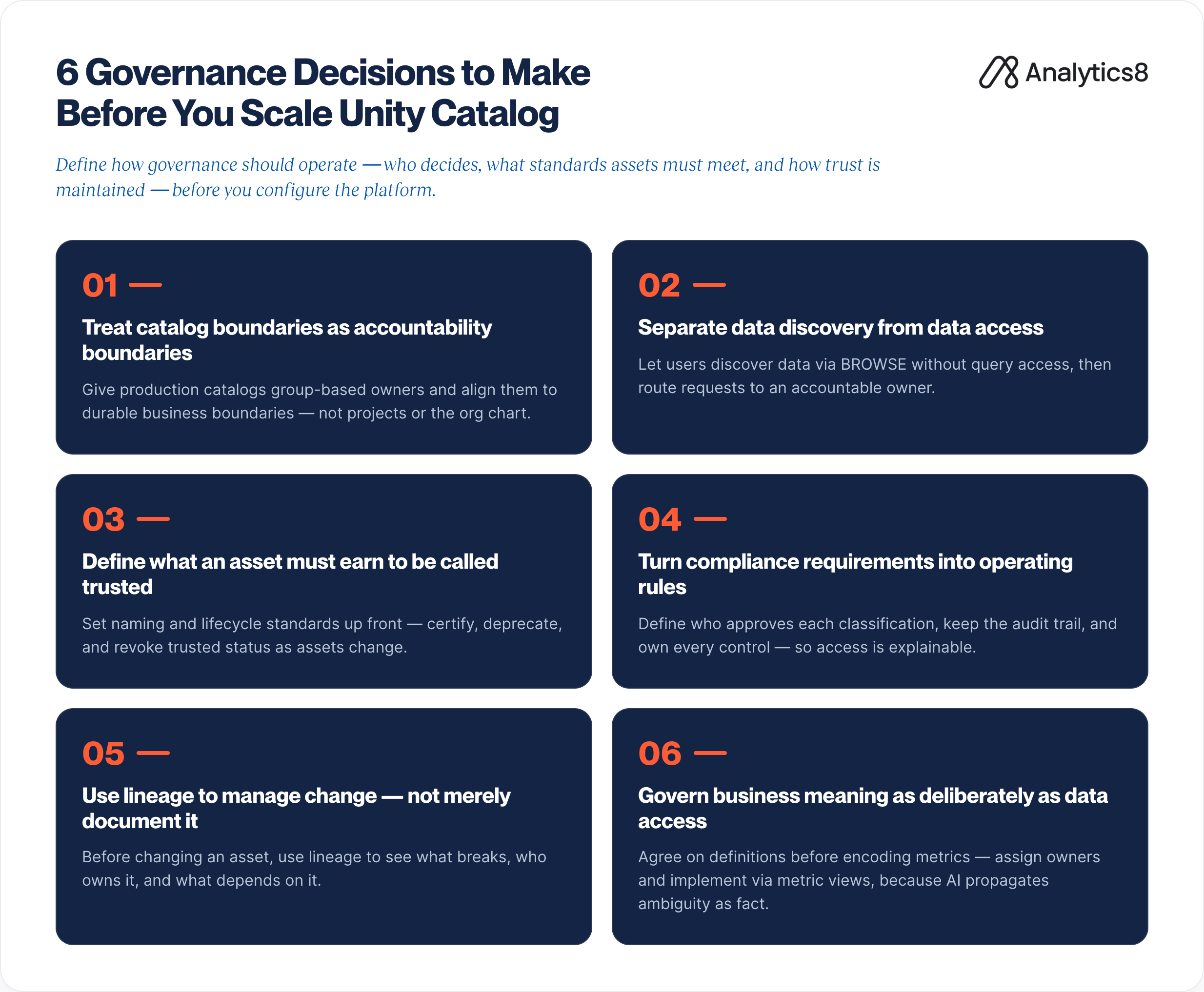
6 Governance Decisions to Make Before You Scale Unity Catalog
1. Treat catalog boundaries as accountability boundaries
Determine the structure by identifying where ownership, access, and data-isolation requirements differ:
- Give every production catalog a group-based owner rather than an individual.
- Organize catalogs around durable business and governance boundaries, not temporary projects.
- Define where new domains belong before teams begin creating their own structures.
- Avoid mirroring the organizational chart too closely because reporting structures change more often than governance responsibilities.
2. Separate data discovery from data access
Organizations often respond to self-service demand in one of two ways: expose too much data or lock it down so tightly that users cannot find anything. Neither scales.
Let users discover that relevant data exists without automatically granting permission to query it. Then give them a defined route for requesting access. Unity Catalog’s BROWSE privilege supports metadata discovery without granting access to the underlying data, while access-request destinations route requests to an accountable owner.
Publish its name, description, owner, and sensitivity classification before making it discoverable. When access is approved, grant it through identity-management groups, apply least-privilege principles, and review access when people change roles and on a regular cadence.
3. Define what an asset must earn to be called trusted
Trust in a Unity Catalog asset must be earned and maintained. Establish naming and maintenance standards before workspaces and assets proliferate so users can identify an asset’s domain, purpose, environment, status, and owner.
Before labeling an asset production-ready, define the checks it must pass. At a minimum, users should know who owns it, what it means, where it came from, how current it is, and when it was last reviewed.
Distinguish certified assets from drafts and experiments. Deprecate assets when they are replaced. Remove trusted status when an asset no longer meets the standard. Apply the same lifecycle to metrics, models, functions, dashboards, Genie agents, and other assets that influence business or AI outputs.
Databricks provides a certification status system tag for marking data, analytics, and AI assets as certified or deprecated, but the organization must define the criteria for each label and who can apply it.
4. Turn compliance requirements into operating rules
Apply compliance requirements throughout the data lifecycle – from classification and access to monitoring, retention, and review.
Define who can approve access to each data classification and how privileged access will be reviewed and revoked. Retain the audit history needed to show who accessed sensitive data and what they did with it. Assign an owner to every compliance control.
The test is simple: the organization should be able to explain who can access sensitive data, why they have access, who approved it, and how that access will be removed.
5. Use lineage to manage change — not merely document it
Before modifying or retiring a table, metric, model, or function, use lineage and ownership metadata to answer three operational questions:
- What will break if this asset changes?
- Who owns the affected downstream assets?
- Which business processes or decisions depend on them?
Make impact analysis part of the change process. Confirm the business effect with downstream owners and notify them before the change reaches production. This makes lineage a practical tool for release management, incident response, and compliance.
6. Govern business meaning as deliberately as data access
A well-structured catalog shows where data came from and who can use it. Shared definitions explain what it means.
In one client meeting, the COO and CFO disagreed when a patient should be recognized. Did the patient count when they checked in or after they checked out? When should revenue be recognized? How should a return visit be calculated if no one agrees on the meaning of “last visit day”?
Resolve those disagreements before encoding metrics or exposing data broadly. Assign business owners to critical terms, document approved definitions and valid variations, and establish a process for changing them. Then implement the approved definitions through your governed semantic layer. Metric Views provide reusable KPI definitions, while Genie Ontology captures business entities, relationships, and context that AI systems use to interpret those definitions consistently.
Even when data is available, if definitions aren’t agreed upon, organizational trust in your analytics will suffer.
AI raises the stakes. A dashboard may display an ambiguous metric and leave a user to question it. An AI agent can propagate that ambiguity across questions and downstream analyses while presenting the results as authoritative.
For one global biopharma company, Analytics8 built a governed Databricks lakehouse where Unity Catalog documents lineage and definitions — removing the organization’s reliance on institutional knowledge. Analysts no longer hunt for answers or debate what a metric means, and reports that once took weeks now run in minutes.
Best Practices for Building a Trusted Semantic Layer for AI
Unity Catalog governs who can access data and where it came from. A semantic layer governs how the business understands that data.
Databricks makes governed data available through Unity Catalog, but governed data alone doesn’t guarantee consistent answers. Dashboards, AI applications, and business users also need a shared understanding of business concepts, metrics, and relationships.
A trusted semantic layer connects governed data with business meaning. As Databricks expands capabilities such as Metric Views and Genie Ontology, organizations should treat semantic modeling as a core part of their platform architecture rather than something built independently for every dashboard or AI application.
Define business concepts before building AI experiences
Agree on the business entities, metrics, terminology, and relationships that matter most across the organization before exposing them through dashboards, Genie, or AI agents.
Questions like these should have one approved answer:
- What is a customer?
- When does revenue become recognized?
- What defines an active account?
- How should repeat purchases be measured?
If business definitions differ across departments, AI will simply reproduce those inconsistencies faster.
Document the Unity Catalog foundation
Once the organization agrees on its core business concepts, document the data assets that support them. Add clear comments and definitions to catalogs, schemas, tables, and columns. Assign owners and use tags to identify an asset’s business domain, sensitivity, status, and intended use.
Document the repositories and pipelines that create or transform those assets, including their purpose, dependencies, and support ownership. Review this foundational information for gaps and outdated descriptions before building Metric Views or adding ontology. These capabilities depend on accurate metadata and documentation to connect technical assets with business meaning.
Define metrics once
Business KPIs should exist in one governed location rather than being recreated across reports, notebooks, and AI prompts.
Metric Views provide reusable KPI definitions that dashboards, SQL, and AI experiences can all reference consistently.
Capture business context — not just metadata
Technical metadata explains where data comes from. Business context explains what it means.
Put that context into Databricks by identifying the proprietary knowledge that explains how your organization operates, such as glossaries, policies, process documentation, and business rules. Create a governed pipeline for bringing approved materials into Unity Catalog Volumes, with defined ownership, access, and maintenance standards. Use CI/CD to deploy and update the ingestion logic and related configurations so this knowledge remains controlled, traceable, and ready to support Genie Ontology.
As Databricks continues to expand Genie Ontology, they’ll be able to define business entities, relationships, synonyms, and concepts once instead of teaching every AI application independently. This shared context allows AI to interpret questions using the organization’s business language rather than relying solely on table names or prompt instructions.
Keep semantics under governance
Treat semantic assets like any other governed asset: Assign owner, review changes, version definitions, retire outdated concepts.
Changes to business definitions should follow the same review process as changes to production code because they affect every downstream dashboard, AI application, and business decision.
Best Practices for Scaling Self-Service Analytics with Databricks Genie
Treat each Genie agent as a governed analytics product with a defined audience, decision set, and data scope. Reliable answers depend on governed data, agreed-upon definitions, and a clear validation standard.
Start with the decisions users need to make
Identify the audience, the decisions they make, and their recurring questions. Use those needs to determine which data and business context the agent requires.
For a revenue-management agent, focus on questions about performance, variance, and business drivers. Start with one domain and a defined question set. Expand the scope after the agent answers those questions consistently and users demonstrate a clear need for more.
A focused rollout keeps the data scope manageable and exposes missing definitions before launch.
Define the agent’s answer contract
Before rollout, document what the Genie agent is expected to answer, what information it requires from the user, and when it should direct the user to another analytics resource.
The answer contract should specify:
- The business questions the agent supports
- The metrics and dimensions it can use
- The conditions that require a clarifying question
- The sensitive or high-risk answers that require additional validation
- When the agent should explain that it lacks enough context to answer reliably
Natural-language responses can sound authoritative even when the agent has interpreted the question incorrectly. The answer contract gives curators, validators, and users a shared standard for evaluating the response.
Build Genie on your enterprise semantic layer
Genie should consume — not redefine — your enterprise semantic layer. Use governed data products, Metric Views, and Genie Ontology so business definitions are maintained once and shared across dashboards, AI applications, and Genie Spaces. Reserve Genie instructions for conversational behavior and edge cases, not core business meaning.
Validate with real questions and expected answers
Prepared demonstrations test carefully selected prompts. Production validation must include the incomplete, ambiguous, and inconsistent questions users ask during actual business workflows.
Build a validation library from recurring reports, analyst requests and business reviews. For each question, document the expected answer, required context, and any clarifying questions the agent should ask.
Have business owners validate financially or operationally sensitive measures before launch. Test both the ideal prompts and natural language variations and configure Genie to ask for clarification whenever the intended definition is unclear.
Treat failed questions as evidence. They reveal missing metadata, unclear definitions, incomplete examples, or a use case that exceeds the agent’s current scope.
Teach users how to evaluate an answer
Focus training on the questions the agent supports, the context users should provide, and the signals that an answer needs further validation.
Users should still validate unexpected results, confirm sensitive measures, and report incomplete or inconsistent answers. Teach them how to provide context, respond to clarifying questions, and escalate potential issues.
Operate Genie as a product after launch
Assign each Genie agent an owner responsible for reviewing adoption, unanswered questions, recurring misunderstandings, and changes to the underlying data or business definitions.
Measure success through business outcomes such as fewer repeated analyst requests, faster answers to priority questions, and greater use of governed data in decision-making. Treat conversation volume as context, not proof of value. High usage paired with frequent corrections signals a quality problem.
Use actual questions and failed interactions to improve the semantic model, validation library, instructions, and training. When users repeatedly ask questions beyond the agent’s scope, evaluate whether to expand the product or guide them to a more appropriate analytics experience.
The foundation built for Genie also strengthens dashboards, embedded analytics, applications, and other agents.
Analytics8 helped a legal services company deliver self-service analytics with Databricks AI/BI and Genie, enabling business users to explore data and answer questions without writing SQL.
Best Practices for Balancing Databricks Performance, Spend, and Business Value
Every Databricks workload should have an owner, a performance target, and a cost expectation. Together, they define what it must deliver, who is accountable, and what the organization will spend.
As Databricks expands across data engineering, analytics, AI/BI, Genie, and generative AI, manage each workload according to its business value and operating requirements.
Connect spending to business value
Platform-wide totals show how much the organization spent. Workload-level visibility explains what created that spend and whether it produced value.
For every production workload, define:
- The business purpose: Which process, decision, or user need does it support?
- The cost owner: Who understands its spending and has authority to act?
- The response threshold: What will the team do when costs exceed expectations?
Use cluster tags to track costs by workload, team, environment, and business use case. Databricks automatically tracks costs in the system catalog. Use these tables to build internal dashboards that make spending easy to monitor and alert the appropriate owners when costs exceed defined thresholds. Review spending alongside usage, performance, failures, and retries. This helps teams distinguish growth driven by adoption from rising costs caused by inefficiency.
Define what acceptable performance means
“Fast,” “scalable,” and “reliable” mean different things across the platform. Translate them into measurable requirements before selecting compute or tuning the workload.
For example:
- A nightly pipeline may need to finish before the business day begins.
- A dashboard may need to load within seconds during peak usage.
- An AI agent may need to meet targets for response quality, latency, and cost per interaction.
Capture a baseline before usage grows. Use it to identify regressions, evaluate changes, and determine whether additional spending produced a meaningful improvement.
Find the source of the performance issues before adding compute
When a workload slows down, determine where it spends its time. Use Databricks monitoring and optimization tools to review job history, queries, failures, retries, data movement, and data organization. Simplify or optimize the workload before increasing capacity.
Additional compute may improve performance temporarily while leaving inefficient code, poor data layout, unnecessary processing, or badly designed queries. At scale, these inefficiencies become recurring operating expenses.
Add capacity only for a demonstrated need, such as higher concurrency or greater data volume.
Match capacity to the demand pattern
Configure scaling, scheduling, and shutdown behavior around how each workload is used:
- Interactive analytics: Prioritize rapid startup and enough capacity to absorb short peaks.
- Scheduled pipelines: Start compute for the job and end it when the work is complete.
- Steady workloads: Maintain predictable capacity that consistently meets the performance target.
Review the configuration as data volume, concurrency, and adoption grow. Persistent delays may indicate a need for additional capacity or a more efficient workload. Long idle periods signal an opportunity to reduce resources.
Manage AI quality, latency, and cost together
For AI applications, performance includes the quality of the result. Define quality, latency, reliability, and cost expectations before moving an application into production.
Use MLflow to trace application behavior, compare versions, evaluate quality, and incorporate human feedback. Use Unity AI Gateway to manage approved model access, usage, budgets, rate limits, and guardrails. Unity AI Gateway and its service policies are currently in beta, so confirm availability before including them in the production operating model.
Before release, the team should be able to answer:
- Which version is running?
- How was it evaluated?
- Which data, models, and tools can it access?
- What does each interaction cost?
- What happens when quality falls below the agreed standard?
Review what the organization still needs
After launch, some workloads grow in value and usage; others become redundant, outdated, or unnecessary.
Review the workload portfolio on a defined cadence. Resize workloads whose requirements have changed, consolidate overlapping capabilities, and retire assets that no longer have an active owner, audience, or business purpose. Successful optimization delivers the performance and quality each workload requires within a cost the organization understands and accepts.
Implementing Databricks with Analytics8 was a critical move for United Vein and Vascular Centers. The platform has allowed us to build a robust Enterprise Data Warehouse from the ground up, automating previously manual processes and enhancing the accuracy and trust in our data.”
Marvin Al-Khafaji, CIO, United Vein & Vascular Centers
Conducting a Databricks Health Check
As teams add workloads, data volumes increase, and business priorities shift, your Databricks configurations, permissions, code, and operating practices can stop reflecting what the organization needs.
Conduct a Databricks health check at least annually and after major changes in workload demand, platform usage, organizational structure, or cost. Review seven areas:
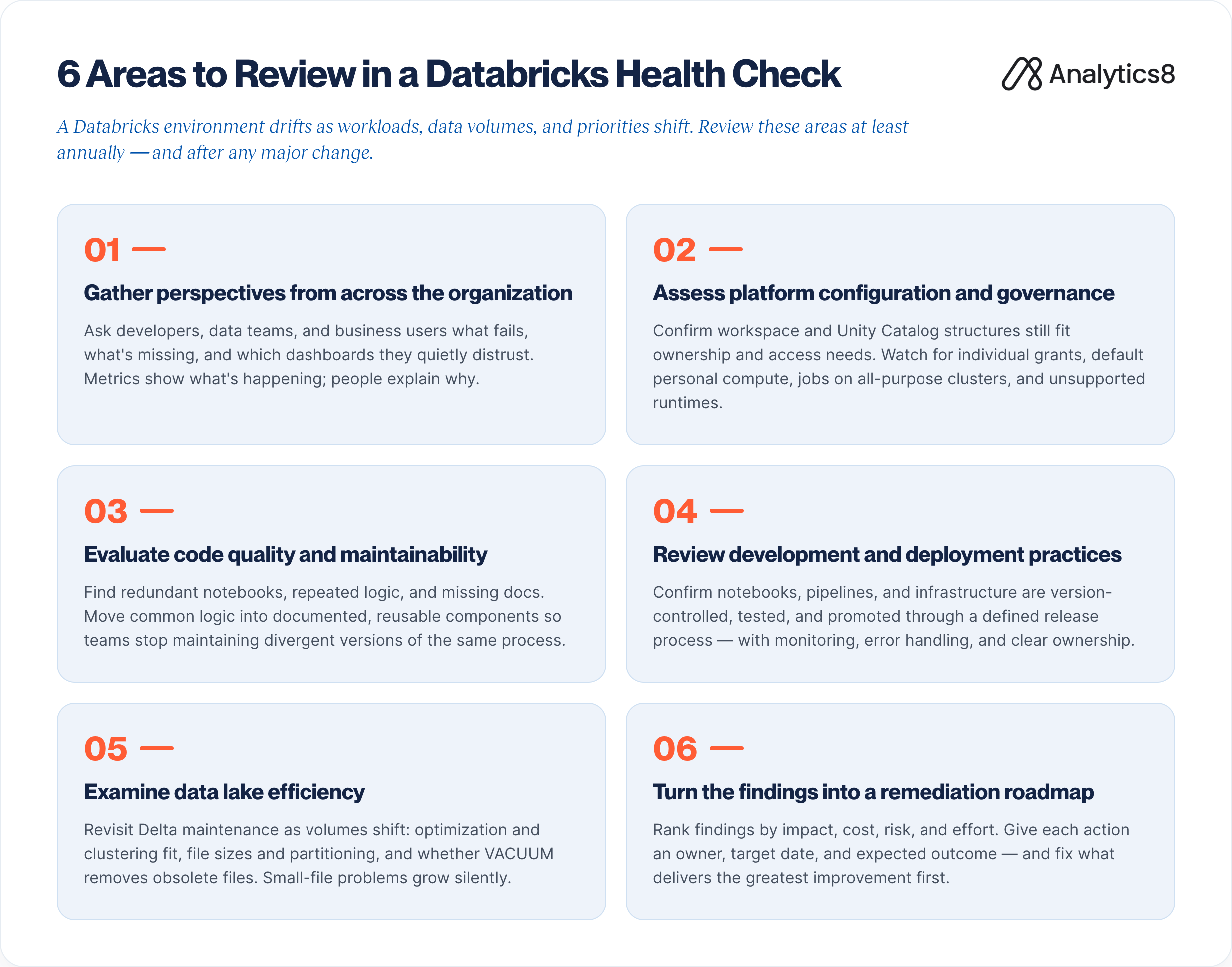
1. Gather perspectives from across the organization
Speak with developers, data teams, platform owners, and business users, and ask questions that surface real problems, not satisfaction scores.
- For technical teams: Which processes fail most often? Where do data discrepancies occur? Which recurring exceptions or manual workarounds have become accepted practice?
- For business users: What data do you depend on daily, what is missing, and where do you double-check results before acting on them?
Platform metrics reveal what is happening; these answers explain why.
2. Assess platform configuration and governance
Review whether workspace, Unity Catalog, and compute configurations still reflect the organization’s ownership, access, isolation, and workload requirements. Look for individual access grants, unclear ownership, unrestricted personal compute, scheduled jobs running on all-purpose compute, idle resources, and outdated runtime versions.
Together, these patterns indicate that day-to-day exceptions have started to replace platform standards.
This retains the useful warning signs while removing the long sentence. The terminology also aligns with current Databricks guidance: Databricks recommends jobs or serverless compute for job workloads and treats Personal Compute as a policy administrators should deliberately manage.
3. Evaluate code quality and maintainability
Identify redundant notebooks, repeated logic, missing documentation, and dependencies that make workloads difficult to change or support. Move commonly used logic into documented, reusable components so teams do not maintain different versions of the same process. Review documentation alongside the code: create it where it is missing, update it when it is outdated, and remove it when the underlying process has been deprecated. Require changes produced with agentic coding tools to include corresponding documentation updates so the codebase remains understandable as development accelerates.
4. Review development and deployment practices
Confirm that notebooks, pipelines, configuration, and infrastructure are version-controlled, tested, and promoted through CI/CD pipelines — such as GitHub Actions, Bitbucket Pipelines, or Azure DevOps — that enforce a defined release process. Examine monitoring, error handling, and ownership so teams can identify failures, recover from them, and determine who is responsible for resolving them.
5. Examine data lake efficiency
Review how data is organized and maintained as volumes and access patterns change. Look for slow queries, excessive small files, outdated partitioning or clustering choices, and obsolete files increasing storage costs. Confirm that automated or scheduled maintenance reflects current usage, retention, and recovery requirements. These problems accumulate gradually and may go unnoticed until performance declines or costs rise.
This is more accessible and avoids implying that every organization should manually manage OPTIMIZE and VACUUM. Databricks now automates those operations for eligible Unity Catalog managed tables through predictive optimization and recommends liquid clustering for many new tables.
6. Review the semantic layer
Confirm that Metric Views, business definitions, Ontology objects, and AI metadata still reflect current business processes. Remove duplicate concepts, retire outdated definitions, and validate that dashboards, Genie Spaces, and AI applications all reference the same governed semantic assets.
7. Turn the findings into a remediation roadmap
Rank findings by business impact, cost, operational risk, and effort. Assign each action an owner, target date, and expected outcome. Address the changes that deliver the greatest improvement first rather than treating every finding as equally urgent. Where remediation introduces new standards or responsibilities, include the training teams need to sustain the change.
For a global supply-chain operator, a Databricks health check uncovered competing workloads, duplicate code, and inconsistent development practices. Analytics8 separated compute resources, consolidated code, and introduced version control and routine updates—reducing compute costs by approximately 20%, improving query performance by 30%, and cutting development and maintenance effort by 15%.
After remediation begins, track whether the changes reduce costs, improve reliability, strengthen governance, or remove friction for users. Use those results to adjust the roadmap and set priorities for the next review.
Talk With a Data Analytics Expert
Key Takeaways
- Databricks delivers the greatest ROI when it is supported by a defined operating model, trusted data, strong governance, disciplined cost management, and measurable business outcomes—not treated as a standalone technology deployment.
- Scalable implementations require early decisions about platform ownership, workspace structure, team onboarding, workload requirements, environment separation, and repeatable CI/CD deployment processes.
- Unity Catalog should establish durable accountability boundaries, separate data discovery from access, define standards for trusted assets, operationalize compliance requirements, and use lineage to manage downstream change.
- A governed semantic layer should define business concepts, metrics, terminology, and relationships once so dashboards, Metric Views, Genie, and AI applications deliver consistent answers from a shared source of truth.
- Genie agents should be treated as governed analytics products with a focused audience, defined question set, clear answer contract, enterprise semantic foundation, real-world validation library, user training, and accountable ownership.
- Performance, spending, and business value must be managed together by assigning every workload an owner, performance target, cost expectation, and business purpose—and by resolving inefficient code or data design before adding compute.
- Adoption and platform health require continuous management through usage monitoring, quality evaluation, cost analysis, code and documentation reviews, semantic-layer maintenance, workload optimization, and the retirement of outdated or redundant assets.