
Last updated on July 13, 2026
How to Build an Effective Data Governance Strategy (with guides)
By Jenna O’Jea
Frustrated by data governance efforts that are too complex or fail to deliver results? A data governance strategy doesn’t have to be rigid or overwhelming. The key is an approach that ensures control without unnecessary overhead — driving quick wins and real business value. This blog walks you through building a data governance strategy that fits your business, balancing structure with flexibility for long-term success.
A data governance strategy ensures your data is reliable, secure, and used effectively across your organization. Without one, data becomes inconsistent, quality suffers, and compliance risks grow.
But to be successful, you need a data governance strategy that is tailor-fit to your business needs — one that will allow you to achieve quick wins and measurable ROI.
In this blog, we cover:
- What is a Data Governance Strategy (and Why You Need One) ↵
- Tips for an Effective Data Governance Strategy↵
- Step 1: Use a Data Governance Framework ↵
- Step 2: Determine the Right Level of Data Governance↵
- Guides to Implement Your Data Governance Program ↵
- Final Tips to Make Your Data Governance Strategy Successful ↵
What is a Data Governance Strategy (and Why You Need One)
A data governance strategy is your high-level plan for managing, protecting, and using data across your organization. It guides decision-making and resource allocation, ensuring that data is consistent, reliable, and aligned with your business goals.
As your organization creates more data — coming in from a variety of sources — you need a data governance strategy to ensure a consistent approach to the valuation, creation, consumption, and control of data.
A lack of a data governance strategy can lead to many challenges, including:
- Inconsistent use of data across your organization: Different departments interpreting and using data in various ways creates confusion and misalignment.
- Poor data quality: Resulting in costly errors, rework, and inefficiencies, poor data quality hampers organizational performance.
- Lack of transparency: The absence of a clear view of data assets may lead to misuse and uninformed decisions, hindering understanding and proper utilization of data.
- Compliance violations: Improper data classification and storage can lead to non-compliance with regulations, posing legal risks and potential penalties.
Tips for an Effective Data Governance Strategy
To build a solid data governance strategy, focus on two critical steps:
- Use a Data Governance Framework: Frameworks help you establish policies, roles, and processes to structure governance across your organization.
- Determine the Right Level of Data Governance: To see ROI on your data governance efforts, choose an approach that aligns with your organization’s needs and data maturity.
Step 1: Use a Data Governance Framework
A data governance framework is the foundation for applying governance across your organization. The framework is a structured approach to defining governance roles, policies, and processes to maintain data quality and security while ensuring governance efforts are aligned across departments.
Not all organizations require the same governance structure. Some industries demand a strict, highly controlled approach, while others need a more flexible framework that can evolve with business needs. Understanding these differences helps in choosing the right model for your organization, which include:
- Traditional frameworks (e.g., DAMA DMBOK) focus on rigid processes, documentation, and top-down control — ideal for highly regulated industries.
- Modern frameworks prioritize flexibility, agility, and cross-functional collaboration, allowing organizations to adapt governance as business needs evolve.
While some organizations need enterprise-wide governance and will use a traditional framework, many of our clients benefit from a modern framework which is designed for flexibility and scalability, allowing governance to adapt as business needs change.
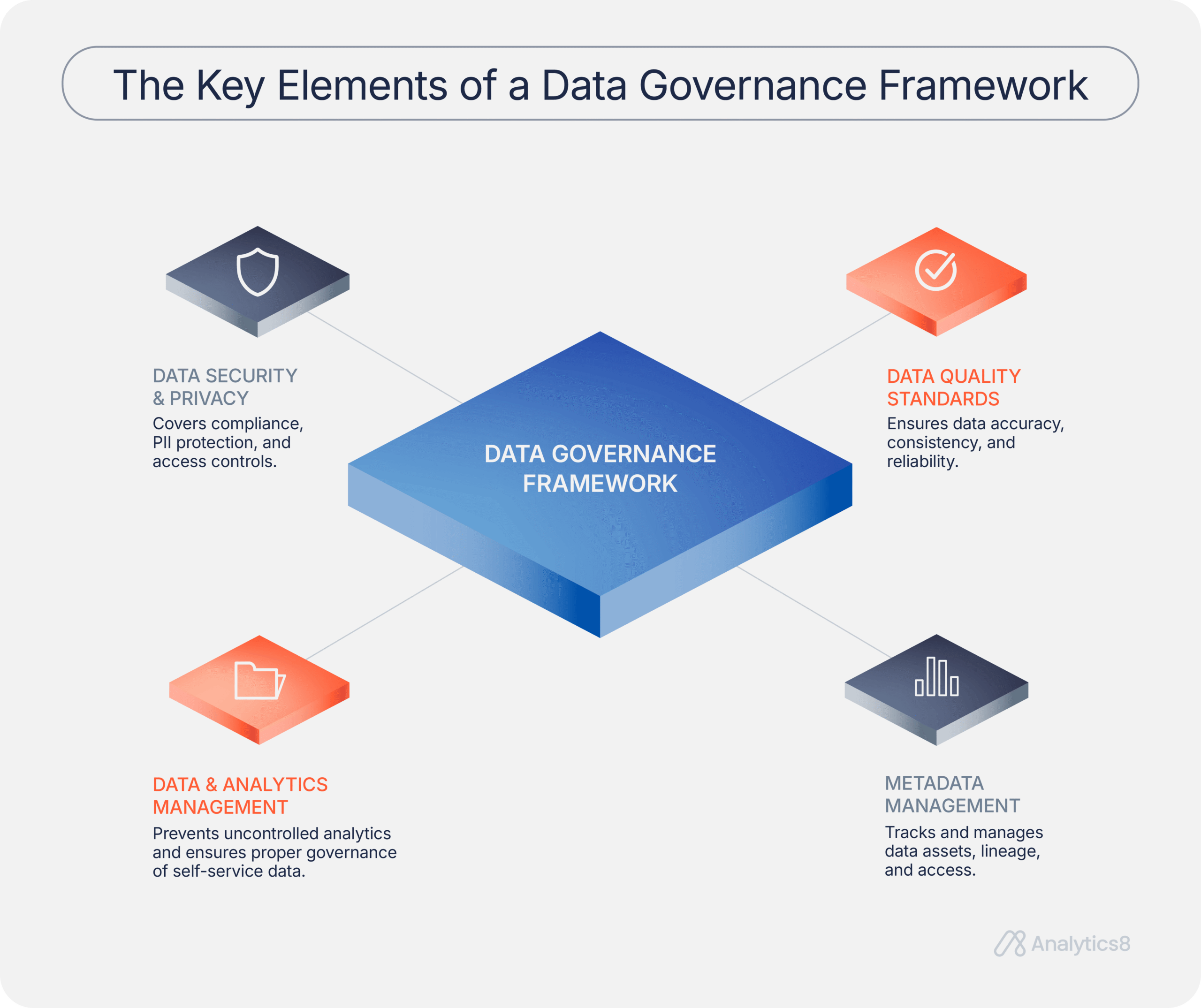
If a more flexible framework is appropriate for your organization, your data governance framework should include:
- Data Quality Standards: This critical aspect of data governance focuses on ensuring the accuracy, consistency, and reliability of data. It includes getting all business stakeholders involved to establish quality rules, implementing programs to track and resolve data quality issues, and monitoring data quality continuously.
- Data and Analytics Management: This aims to prevent uncontrolled analytics practices and maintain governance over data and analytics activities. This is where you establish guidelines and controls for self-service analytics to ensure proper data usage and avoid “wild west” scenarios.
- Metadata Management: This is the understanding and management of data assets, their usage, and associated metadata. This allows you to track and control data assets, identify data lineage, and manage data access and usage within your organization.
- Data Security and Privacy: This encompasses regulatory compliance, protection against data breaches, and managing data usage permissions. Address regulations such as GDPR, CCPA, HIPAA, and protect Personally Identifiable Information (PII) while defining appropriate data access and usage policies.
Step 2: Determine the Right Level of Data Governance
There isn’t a one-size-fits-all approach to data governance. Your data governance program should align with your organization’s size, data maturity, business needs, risk tolerance, and regulatory requirements. This is how you ensure your governance efforts are practical, scalable, and valuable — rather than a burdensome overhead.
How would you rate your organization when it comes to data governance maturity?
- Inactive: Governance efforts are minimal or siloed, with different departments handling data inconsistently. There are no formal policies, and data issues are often addressed on an ad-hoc basis.
- Reactive: Governance is implemented in response to issues — such as poor data quality, security concerns, or regulatory audits — but lacks a long-term, structured approach. Governance efforts may be sporadic, driven by compliance needs rather than business strategy.
- Proactive: Governance is a structured, ongoing effort, embedded into business processes. There is clear ownership of data, governance policies are well-defined, and governance actively supports decision-making, security, and regulatory compliance.
Why does this matter? Understanding your current maturity level helps you set realistic governance goals and improve your data governance maturity without taking on too much, too quickly.
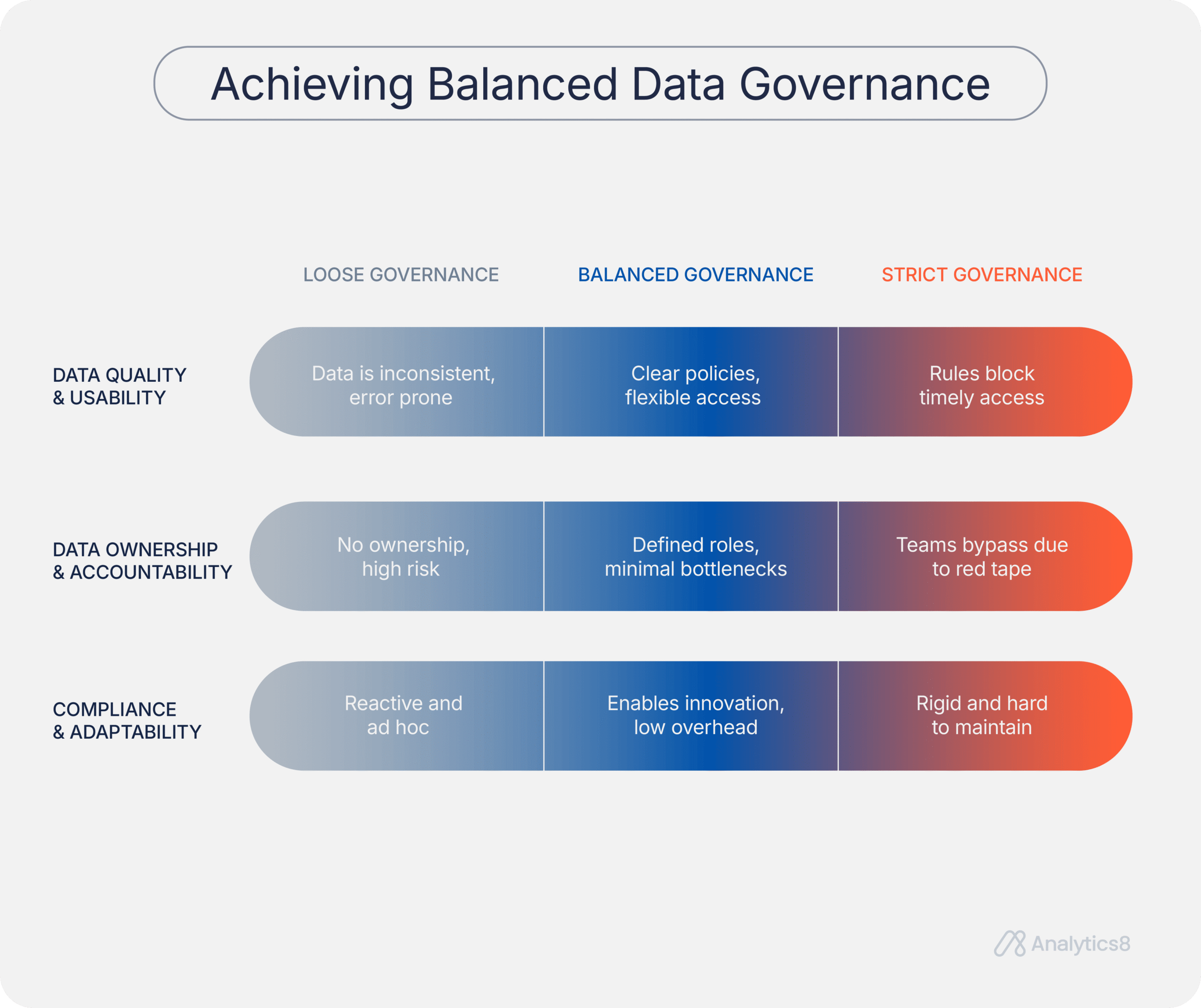
Other factors to consider when selecting the right governance level include:
- Your strategic business objectives: How does data governance (or the lack of it) impact your organization’s growth, efficiency, and decision-making?
- Your current challenges: What pain points (e.g., poor data quality, lack of compliance, security risks) need immediate attention?
- Your level of regulatory requirements: Do you operate in a highly regulated industry (e.g., healthcare, finance) that requires strict governance controls?
After determining the right governance level, the next step is implementing a structured program that fits your organization’s needs.
A Guide to Build Out Your Data Governance Program
What is a Data Governance Program?
A data governance program defines how to implement your data governance strategy. It provides guidelines to translate the policies, procedures, structures, roles, and responsibilities outlined in the data governance strategy into tangible actions.
Guide to Start Building Your Data Governance Program
Iterative Data Governance: An iterative data governance approach allows you to start with foundational practices and scale over time, prioritizing high-impact use cases while adapting to your organization’s evolving needs. This method delivers quick wins, aligns governance with business objectives, and provides the flexibility to refine processes as you grow.
GUIDE: ITERATIVE DATA GOVERNANCE PROGRAM (Download the guide)
An iterative data governance approach allows you to start with foundational practices and scale over time, prioritizing high-impact use cases while adapting to your organization’s evolving needs. This method delivers quick wins, aligns governance with business objectives, and provides the flexibility to refine processes as you grow.
Follow these six steps to implement it effectively:
Step 1: Uncover High-Value Use Cases
Identify high-value data governance use cases by aligning them with business objectives and challenges. Weigh the benefits — such as improved data quality, better decision-making, and increased compliance — against potential risks like data breaches or operational disruptions. Prioritize use cases by:
- Pinpointing Challenges: Zone in on issues to unearth impact use cases.
- Assess Impact vs. Risks: Balance the potential positives and risks of each case.
- Prioritize Efficiently: Rank scenarios to optimize resource distribution.
- Engage Stakeholders: Connect with key players to understand data governance-centric hurdles and prospects.
- Quantify Benefits: Gauge the advantages of addressing these challenges through data governance strategies.
Tip to avoid scope creep: For your first use case, keep it simple and collaborate with a singular business unit.
Step 2: Document Business Impact Factors
Documenting the business impact of your data governance initiatives provides tangible evidence for organizational buy-in. It justifies investment and serves as a foundation for ongoing improvements. Here’s how to analyze business impact and demonstrate ROI:
- Define Measurable Metrics: Choose specific, quantifiable KPIs that match each use case’s objectives.
- Do a Baseline Assessment: Perform an initial benchmark assessment to establish the current state of chosen metrics.
- Monitor Your KPIs: Regularly assess impact of your data governance initiatives and gauge effectiveness in achieving business outcomes.
- Communicate Your Findings: Consistently showcase the value of your data governance program to all stakeholders.
Tip: The most impactful KPIs demonstrate improvements like cost savings, increased efficiency, risk reduction, decision-making enhancement, or customer satisfaction improvement.
Step 3: Drill Into Technical Feasibility Factors
Things like your data infrastructure, security protocols, and the technical proficiency of your staff will be a big factor in determining the practicality of a use case within your organization. Before going too far in your planning, do a thorough examination of the following aspects of your technical framework:
- Data Access: Determine how readily and conveniently the required data can be accessed. Inspect factors like data sources, quality, integration potential, and existing governance procedures.
- Data Infrastructure & Technology: Assess the present data infrastructure and technology suite for their capacity to meet the use case’s demands. Focus on aspects such as storage capacity, processing ability, scalability, and software compatibility.
- Examine Integration Potential: Ascertain the compatibility of the use case with existing systems and workflows. Evaluate how seamlessly it integrates with business software, databases, or data management systems.
- Gauge Technical Proficiency: Appraise the availability and aptitude of technical expertise and resources. Reflect on requisite skills, IT resource availability, and the potential to manage infrastructure enhancements or upkeep.
- Security & Privacy Considerations: Delve into the security and privacy concerns associated with the use case. Ensure you have robust mechanisms in place to safeguard critical data and comply with pertinent regulations.
Technology tip: Refrain from creating custom solutions. Technologies in the modern stack offer adequate “out-of-the-box” functionality to help with data governance initiatives.
Step 4: Collaborate, Validate, Update, & Iterate
Involve stakeholders and subject matter experts in the validation and iteration process to ensure the relevance of your use cases. Their feedback can help adjust priorities and determine effective actions. Here are structured ways to drive engagement:
- Validate Use Cases: Tap into the knowledge of those directly immersed in operations to verify feasibility, potential impact, and alignment with overarching organizational objectives.
- Update Use Cases: Keep use cases timely and relevant by revising them in response to new data or evolving organizational requirements.
- Embrace Iterative Refinement: Foster a dynamic feedback loop with stakeholders and experts. This continuous refinement ensures alignment with changing organizational demands.
Tip: Regularly measure against defined KPIs to ensure accountability. If an aspect falters, act swiftly — adapt, communicate the change, and pivot without waiting for routine check-ins.
Step 5: Identify ROI, Dependencies, and Quick Wins
Evaluating each of these factors gets you closer to selecting the most optimal first use case for data governance — one that brings quick value and provides a solid foundation to iterate from and the traction you need to keep moving forward.
- Determine ROI: Weigh the true costs associated with your planned data governance efforts against the anticipated value, such as better data quality (better decisions), heightened efficiency (less waste), and compliance (decreased risk).
- Acknowledge Dependencies: Know the ties between your data governance initiatives and the rest of the business. Consider all your business processes, systems, and technology platforms to minimize disruptions and amplify synergies.
- Spot Quick Wins: Identify initiatives that promise prompt advantages and can be rolled out swiftly. Early victories foster enthusiasm, solidify stakeholder commitment, and set the stage for more extensive governance efforts.
Tip: When pinpointing quick wins, ensure they resonate with leadership. Use the “five whys” technique to validate your choice of use case. If you can’t answer all five, reconsider your selection.
Step 6: Pilot a Single Use Case
Kickstart your governance initiative by test-driving a crucial use case through a pilot phase.
Here’s how to execute a pilot:
- Focus on a Key Use Case: Concentrating on a single, high-value use case enables a targeted application of resources and increases the likelihood of deriving substantial benefits. This focused approach also facilitates in-depth performance analysis.
- Cultivate a Controlled Setting: Establish a controlled environment to unveil and tackle potential obstacles. This ensures the integrity of your pilot and serves as a protective measure before expanding the initiative.
- Embrace the Learning Curve: Use the pilot phase as a rich learning ground. Accumulate feedback, assess alignment with business goals, and scrutinize the practicality of your use case. Draw upon this data to adjust your strategies and refine your methods.
Tip: Maintain a manageable and measurable scope for your pilot. Schedule regular check-ins to evaluate progress and adjust as necessary. Communication is key — ensure any alterations to the pilot are thoroughly communicated to all stakeholders. [/expand]
Final Tips to Make Your Data Governance Strategy Successful
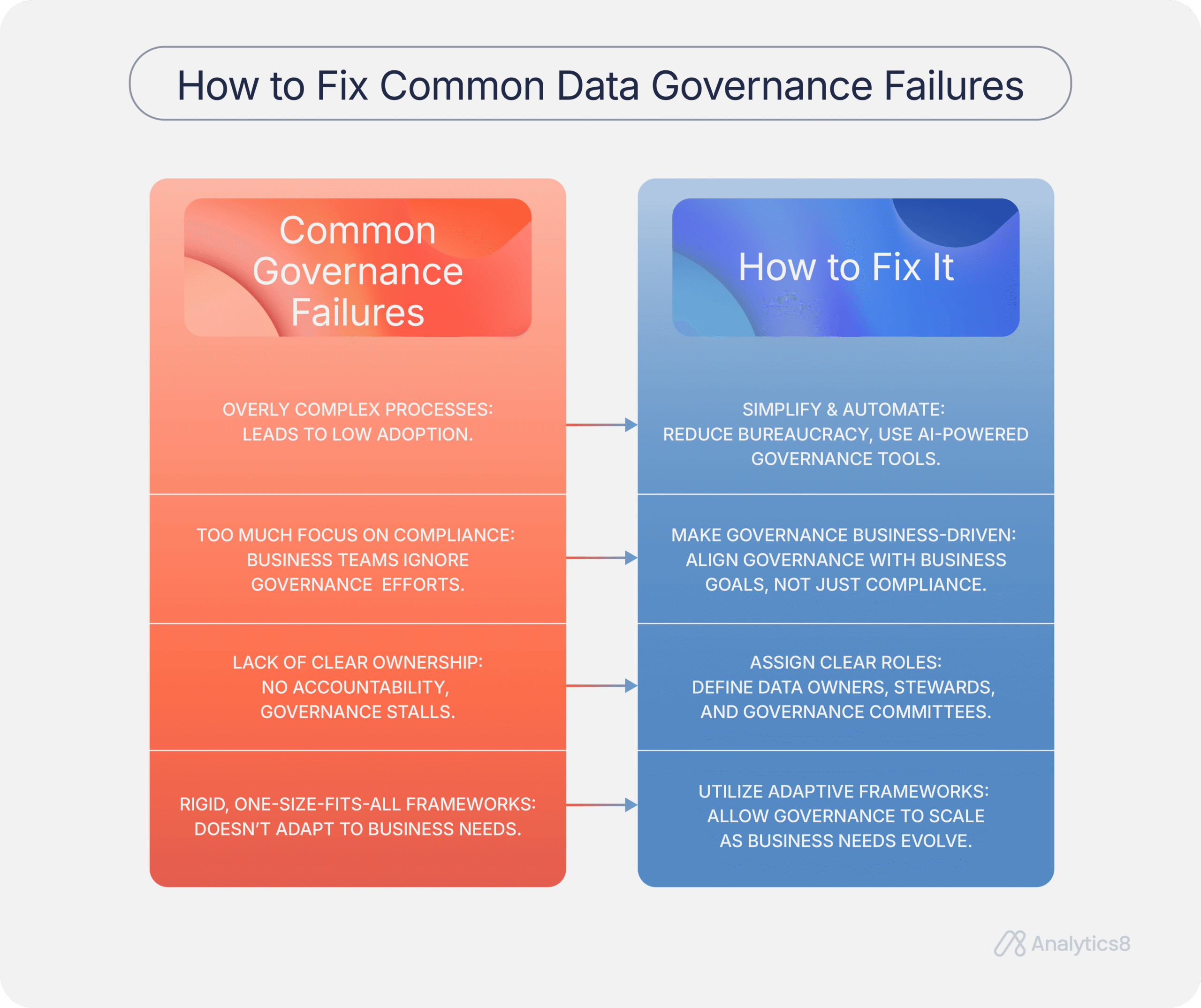
Implementing data governance isn’t a one-time effort — it requires a structured approach, ongoing adjustments, and business-wide collaboration. From defining your strategy to selecting the right framework, each step plays a role in long-term success of your data governance program. As you refine your approach, keep these key principles in mind:
- Embrace adaptability: Recognize that data governance is an ongoing journey rather than a fixed destination. Stay open to adapting your program as per evolving organizational goals, market dynamics, and data sources. Actively assess and adjust your program to meet changing needs.
- Prioritize change management: Drive user adoption by integrating change management into your program. Connect it with business objectives and ongoing projects. Clearly communicate changes and their impact on business users. Define their data governance roles and responsibilities in the process, provide relevant training on data literacy, and celebrate successes, big or small.
- Focus on intention, not complexity: Develop a well-defined plan, clearly outlining expectations and objectives. Ensure everyone involved understands and supports the plan. Establishing the right people and processes is crucial for immediate value and long-term success. With this approach, your data governance program will enhance data quality and analytics, benefiting the entire organization.
By following these tips, you can enhance the effectiveness of your data governance program, leading to improved data quality and analytics, and ultimately aligning your business with its objectives.
Talk With a Data Analytics Expert
Key Takeaways
- A governance strategy ensures reliable, secure, and compliant data, preventing quality issues, inconsistent usage, and regulatory risk.
- Modern frameworks balance control and flexibility, combining standards for quality, security, metadata, and analytics oversight.
- Tailor governance to your organization’s maturity and needs—avoid one-size-fits-all models.
- Balanced governance enables trust and accountability without slowing innovation.
- Select frameworks and rollout approaches that fit your goals: traditional vs. modern, iterative vs. enterprise-wide.
- Keep it simple and business-focused—prioritize ownership, automation, and impact over heavy documentation.
- Support adoption with change management, clear roles, and ongoing alignment to business objectives.