Last updated on September 29, 2026
Databricks Genie Ontology: Giving AI the Business Context It’s Missing
By Tracey Doyle
AI is only as useful as the business context it reasons over. AI can deliver answers faster than ever, but without the right context, faster doesn’t necessarily mean more accurate or trustworthy. In a recent Analytics8 webinar with Databricks, our panelists explored why business context is the missing piece for enterprise AI and how Databricks Genie Ontology helps close that gap.
The cost of missing business context
Right now, most companies are using AI whether the output is right or not. Teams are drafting reports, summarizing pipelines, creating dashboards for board meetings, and answering executive questions in seconds. Speed has become the metric everyone watches, and few are checking whether the answers hold up.
That gap will get expensive. When an AI agent reports revenue using the wrong definition, pulls from a retired sales playbook, or merges numbers from three dashboards that disagree, the decision built on top of it is wrong too. The companies that act on that kind of output at scale will feel it in their forecasts, their customer relationships, and their margins.
The companies that pull ahead will be the ones that give their AI as much trusted business context as possible. That is the problem Databricks set out to solve with Genie Ontology.
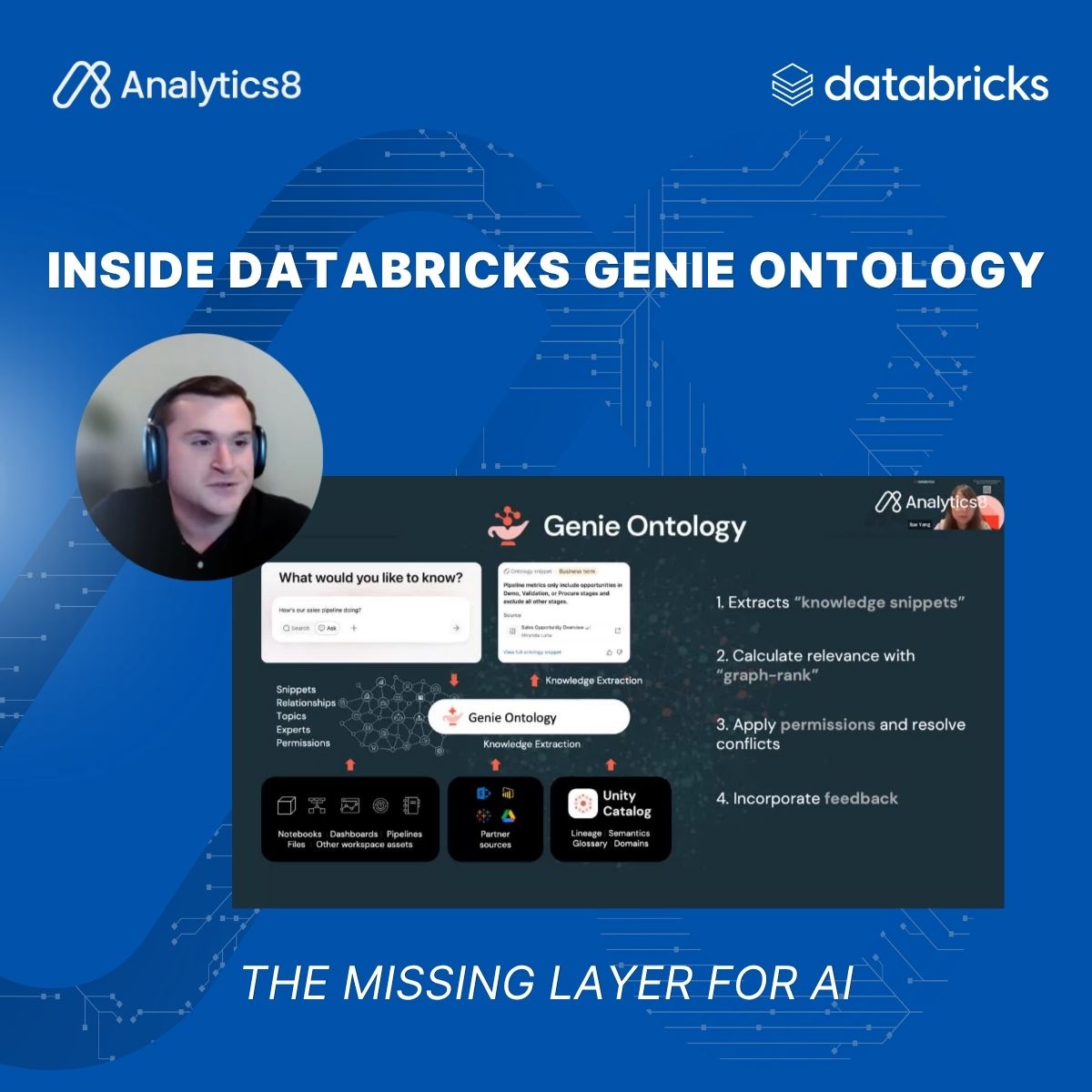
Speed isn’t the problem with enterprise AI — trust is. In this webinar with Databricks, we dig into why business context is what’s actually missing, and how Genie Ontology helps close that gap.
We started the session with a poll: Is your data ready for AI agents? Only 18% of attendees said yes. About half said no, and more than a third weren’t sure.
Yet agents are running. The goal now is to make sure organizations can trust what they produce.
Where AI breaks down in the enterprise
AI demos look brilliant because humans have already done the hard part. As Xue Yang, Partner Solution Architect at Databricks, pointed out, a demo usually runs on a clean dataset, a question everyone agrees on, and a known correct answer. The agent walks a path someone paved for it.
In a real enterprise, that path is rarely, if ever, that clean. The agent runs into problems that have nothing to do with how smart the model is:
Michael Kollman, Senior Databricks Consultant at Analytics8, described the institutional knowledge problem this way: every company has someone who has been there 20 years and is the go-to person for a certain topic. AI can’t walk over and ask them.
Kevin Lobo, EVP of Consulting at Analytics8, said he runs into the same wall in his own agentic workflows. After more than 11 years at Analytics8, he carries knowledge that isn’t represented anywhere his agents can reach, so he fills the gaps by hand.
There’s also the volume problem. Using AI is like hiring the fastest workers on Earth. They can do a huge number of tasks, but without the right structure around them, you end up buried in output you can’t trust or use.
Why business context is so hard for AI
The bottleneck isn’t model intelligence. Models are powerful, and more capable ones ship every few months. The bottleneck is access to accurate, trusted context.
Imagine hiring a brilliant analyst and, on day one, handing them raw table dumps with no data dictionary, no access rules, and no one to ask. They won’t produce good work. That’s not because they lack talent. They lack the context every good analyst builds up over time. Your AI is in the same position.
Four pieces of context are usually missing:
- Trusted definitions. Most companies have no single, governed definition for their key metrics.
- Governance and permissions. AI can’t know who is allowed to see what. Without that, answers are either unsafe or so restricted they’re useless.
- Lineage. AI can’t tell whether an answer traces back to a trustworthy source.
- Semantic meaning. AI sees column names, not what those columns mean to your business.
There’s a fifth that many teams overlook: versioned business knowledge. Say your AI reads a sales playbook as part of an agentic workflow. What happens when you publish a new one? Is the old version still sitting in a place an agent can’t find? Is it tagged as outdated and pointed to its replacement? Kevin has seen this happen in practice: agents that draft RFP responses by searching a company’s shared drive can pull in material that’s a decade old, simply because nothing marks it as outdated.
Your operational documents need the same versioning and metadata discipline you apply to your data.
Why Databricks built Genie Ontology
Databricks built Genie Ontology to give AI a map of what your business means, not just what your data contains. It is the context layer that sits between your governed data and your agents.
Databricks co-founder and CEO Ali Ghodsi explained the thinking behind it in a recent interview. He often asks conference audiences whether they think AI is smarter than most of the people around them most of the time, and nearly every hand goes up. Yet inside most enterprises, AI is used as a chatbot for one-off questions or as a coding assistant. When he asks who has hundreds of agentic co-workers collaborating and keeping them up to date, no one raises a hand.
His diagnosis is that enterprise context is missing.
That context lives in people’s heads, in the decisions made every day, in recorded meetings, and in email. Databricks calls the structured version of that knowledge an ontology, and Genie is built to capture it and feed it to AI.
Ghodsi was also clear that this isn’t a product you buy and forget: “Turns out you have to also build this ontology.” Many Databricks customers use the same product but haven’t built their context the way Databricks has for itself.
In Databricks’ reference architecture, the stack builds from the bottom up:
This maps closely to the Analytics8 Data Value Model
For years, the industry focused on the bottom half of that pyramid: ingesting source data, transforming it, and making it ready for analytics. The top half, where intelligence, decisions, and automation live, got far less attention. The same reliable practices now need to extend upward.
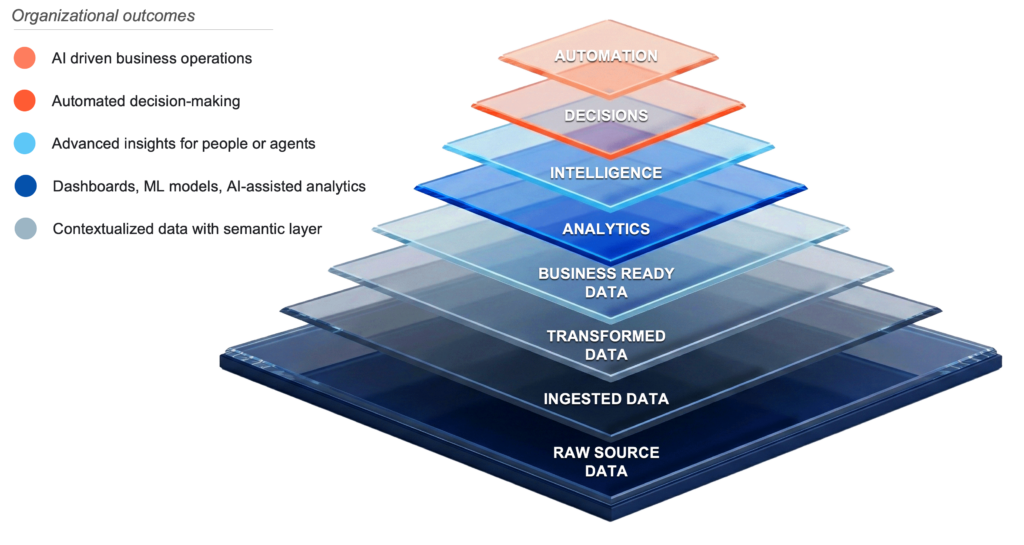
It’s no longer enough to have AI-ready data. You need to be an AI-ready enterprise, where definitions, knowledge, and governance travel with the data so agents can make decisions inside real workflows instead of acting as chatbots with partial knowledge.
How Genie Ontology works
Genie Ontology is a self-improving knowledge graph. It learns from what your teams already build in Databricks, including dashboards, notebooks, and pipelines, and gets smarter the more the platform is used.
It works in four steps:
- Extract. It pulls knowledge from your existing Databricks assets and stores it in the ontology.
- Rank. An algorithm called OntoRank, modeled on PageRank, scores each piece of knowledge by authority, usage frequency, ties to certified assets, and freshness. The most trusted, most used context rises to the top.
- Search at query time. When a question comes in, it retrieves the freshest relevant context and applies permissions on the fly.
- Inject. It feeds that context into the agent loop so the answer references the right source.
You shape what the ontology learns through three Unity Catalog features:
- Metric views let you define and certify KPIs across the organization, turning documented business logic into calculations the platform can use.
- Glossary lets you author business terms and taxonomies, connect them to the underlying data, and capture relationships between them. Genie Code can draft glossary pages and flag definitions that have drifted from how the data is used.
- Domains organize assets by business unit, geography, or function.
The better your metadata, the better Genie Ontology performs. In a Databricks benchmark, Genie One with Genie Ontology support raised accuracy on business-context questions from roughly 50% to more than 80%.
Context also controls risk and cost
Trusted context doesn’t just improve accuracy. It keeps AI safe and affordable to run at scale.
On governance, permissions, lineage, and certified definitions have to travel with the data so agents inherit them automatically. Unity AI Gateway serves as one control point for every agent, model, tool, and dataset, including agents built outside Databricks. One key capability is contextual policy, where rules respond to the data itself, not just the user’s role. An agent handling sensitive customer data might be allowed to email a coworker, required to ask a human before pushing that data into the CRM, and blocked from sending it anywhere public.
On cost, every model call, tool call, and workflow step adds up. Smart routing sends complex tasks to frontier models and simple ones to cheaper or open-source models, so you stop paying frontier prices for trivial work. Agent tracing shows every call, decision, and dollar spent.
Here’s a useful way to frame it: a semantic layer is a way to control token spend. Without governed definitions and lineage, you’re setting an agent loose to burn through tokens hunting for the most probable answer. With them, the agent knows where to look.
What winning companies are doing now
The companies that win with AI won’t be the fastest adopters. They’ll be the ones whose AI reasons over context they can trust. Here’s where to start:
- Agree on your definitions. Document business descriptions for every table and column, and certify your KPIs with metric views. This helps people as much as AI, since it ends the three-dashboards-three-numbers problem.
- Treat knowledge like data. Version your playbooks, guides, and policies. Tag outdated material and point it to its replacement.
- Put governance first. Decide what agents should and shouldn’t see before you deploy them, not after. The old “build first, govern later” model doesn’t hold up when agents are making decisions.
- Use the full platform. If you only use Databricks for data engineering, you’re missing the pieces that make AI trustworthy. Unity Catalog is more than security and governance. It’s the brain of the platform.
Speed will always be tempting. But fast answers built on missing context lead to fast mistakes. Invest in context now, and your AI becomes something you can make decisions with.